
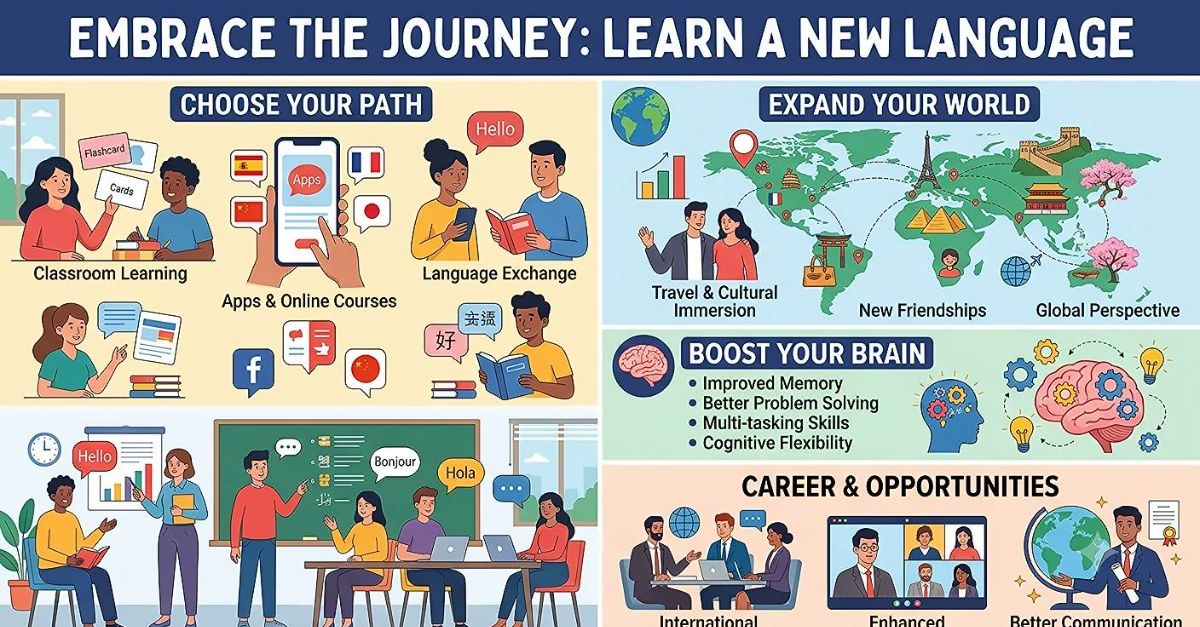
Traditional language learning is broken. Sitting in a classroom conjugating verbs for three years rarely produces someone who can have a real conversation. The good news: language acquisition science has advanced dramatically, and the methods that actually work are all free or very cheap.
The Core Principle: Comprehensible Input
Linguist Stephen Krashen's input hypothesis — validated by decades of research — states that we acquire language not by memorising rules but by understanding messages slightly above our current level. This means your primary activity should be understanding real language (reading and listening), not drilling grammar or memorising word lists in isolation.
Phase 1 (Days 1–14): Build a Foundation
Learn the 500 most common words in your target language using Anki, a free spaced-repetition flashcard app. Download a pre-made deck for your language — this already exists for Spanish, French, German, Japanese, Mandarin, and dozens more. Study 20 new cards per day for 30 minutes. Also memorise basic sentence patterns: "I want," "I have," "Where is," "How much." This gives you the skeleton onto which everything else attaches.
Phase 2 (Days 15–45): Immersion Begins
Switch to immersion-based learning. Watch YouTube channels and TV shows in your target language with subtitles in that language (not English). Start with content made for children or language learners — comprehension is more important than challenge at this stage. Use Language Reactor (a Chrome extension) with Netflix to get dual subtitles and look up words instantly. Aim for 60–90 minutes of immersion daily.
Phase 3 (Days 46–90): Speak from Day 46
Many learners delay speaking until they feel "ready" — this is the most counterproductive instinct in language learning. Book sessions on iTalki or Preply with a community tutor (not a professional teacher) for $5–10/hour. Have conversations about simple topics. Make mistakes fearlessly — comprehensible error is how your brain calibrates. Combine daily immersion with three one-hour speaking sessions per week.
Free Tools That Actually Work
- Anki — Spaced repetition flashcards (free on desktop, $25 on iOS)
- Language Reactor — Chrome extension for dual subtitles on Netflix/YouTube
- Dreaming Spanish — Thousands of hours of comprehensible Spanish input videos (free tier available)
- italki — Affordable tutors and language exchange partners
- HelloTalk — Language exchange app with native speakers worldwide (free)
What to Expect at 90 Days
At 90 days of consistent effort (1.5–2 hours daily), most learners reach B1 level in Romance languages — enough to hold basic conversations on familiar topics, understand slow native speech, and read simple texts. East Asian languages (Japanese, Mandarin, Korean) require more time due to writing systems and tonal components; expect A2–B1 at the same investment.
The One Non-Negotiable
Consistency beats intensity. Thirty minutes every day produces far better results than three hours every Saturday. The brain consolidates language during sleep, which means daily exposure creates compounding returns. Missing days breaks the spaced repetition cycle your brain depends on for retention.

Comments