
AMD Ryzen 9000 X3D vs Intel Core Ultra 200: Next-Gen Architecture Breakdown
The current desktop processor market presents a radical shift in how we measure hardware value. Rather than simply scaling clock speeds or throwing more electricity at a piece of silicon, both AMD and Intel are tackling processing limits through distinct, experimental engineering paths.
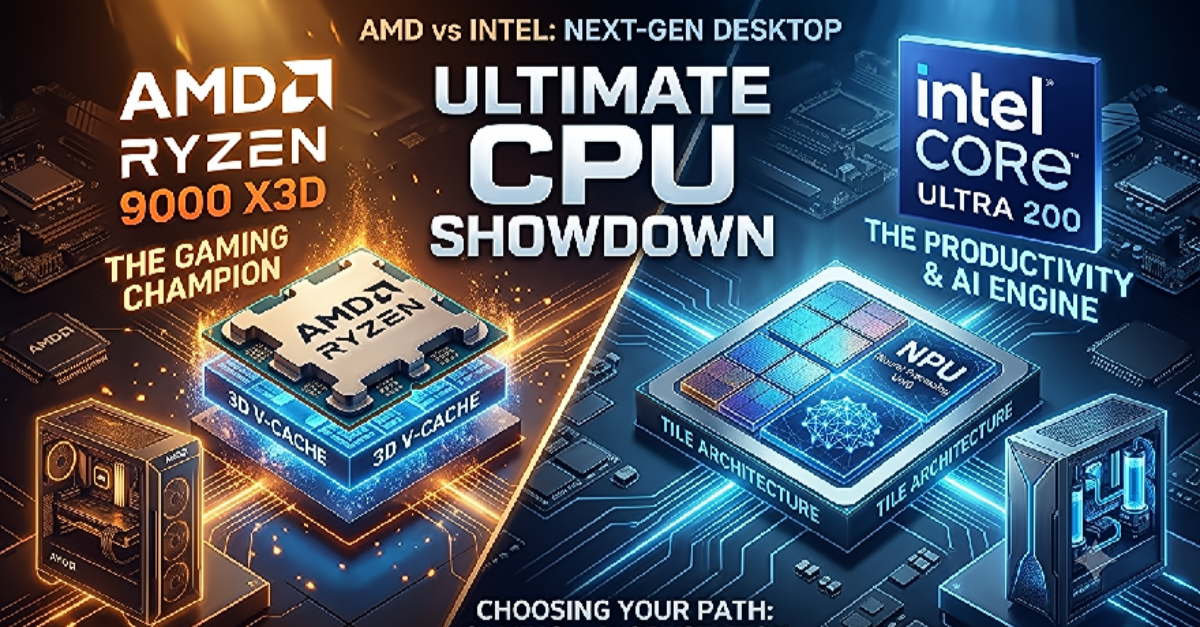
AMD's latest Ryzen 9000-series processors utilize the "Zen 5" instruction engine, engineered precisely alongside their advanced 3D V-Cache hardware. In contrast, Intel has dropped their long-standing "i-series" branding to launch the Core Ultra 200 series (known colloquially as Arrow Lake). Intel's strategy pivots heavily toward a modular tile construction mixed with a dedicated on-die NPU (Neural Processing Unit) aimed squarely at running local AI tasks cleanly.
"We are no longer looking at minor speed bumps; this is an aggressive divergence in philosophy. AMD is optimizing physical memory layout for pure engine velocity, while Intel is restructuring the die to favor multi-tile logic execution."
Why Choose AMD Ryzen 9000 X3D?
AMD's specialized X3D lineup (such as the highly praised Ryzen 7 9800X3D) positions itself ahead of competitors in several specific ways:
- Eliminating Memory Bottlenecks: By integrating a massive block of high-density Level 3 cache directly underneath the core complex, the CPU reduces data fetch cycles radically. For rendering real-time game logic, this is the most direct physical performance boost available.
- Excellent Power Draw and Thermal Control: Built on advanced TSMC process nodes, these chips run significantly cooler and draw much less wattage under full gaming loads compared to high-power processors of the past.
- AM5 Platform Longevity: AMD continues to support the AM5 motherboard socket. Building on this standard means your motherboard will receive straightforward processor upgrade compatibility for years to come.
Budget and Price-to-Performance Breakdown
When calculating system building costs, you must account for both the price of individual silicon and the total platform requirements (such as matching motherboards and high-frequency DDR5 memory).
| Processor Model | Core Configuration | Architecture Focus | Platform Cost Factor |
|---|---|---|---|
| AMD Ryzen 7 9800X3D | 8 Cores / 16 Threads | Ultra-low Latency Gaming | Highly Economical (AM5 Retroactive) |
| Intel Core Ultra 7 265K | 20 Cores (8P + 12E) | Balanced Productivity / AI Work | New Motherboard Needed (LGA 1851) |
| Intel Core Ultra 9 285K | 24 Cores (8P + 16E) | Heavy Compute / Content Creation | Premium Board + Cooling Required |
| AMD Ryzen 9 9950X3D | 16 Cores / 32 Threads | Enthusiast Hybrid Work & Play | Flexible AM5 Platform Ecosystem |
Pros & Cons Comparison
AMD Ryzen 9000 X3D
✓ Pro: Absolute performance leadership across modern high-refresh-rate gaming applications.
✓ Pro: Substantially lower thermal output and power consumption during standard entertainment loads.
✓ Pro: Drop-in compatibility for users utilizing existing high-end AM5 boards.
✗ Con: Higher absolute price-to-core ratios when matched purely against mid-range rendering alternatives.
✗ Con: Lacks an on-die, dedicated high-TOPS NPU for accelerated native AI developer tools.
Intel Core Ultra 200 Series
✓ Pro: Exceptional scaling in synthetic multithreaded math, database manipulation, and rendering suites.
✓ Pro: Native, hardware-level NPU engine processing local AI tasks efficiently without stressing your GPU.
✓ Pro: Competitive out-of-the-box entry pricing metrics for productivity-focused users.
✗ Con: Complete lack of Hyper-Threading can cause specific multi-core scaling penalties in legacy applications.
✗ Con: Requires a hard physical migration to a brand new motherboard line (LGA 1851), increasing total build outlays.
Architectural Analysis: How Both Processors Work
The divergent performance metrics are caused explicitly by distinct choices in chip architecture and layout.
AMD’s Execution Vector: Physical Cache Inversion
In earlier iterations, stacking 3D cache directly on top of the processing cores created a physical thermal insulation barrier, locking in heat and limiting maximum operating frequencies. AMD resolved this challenge in the Ryzen 9000-series X3D line via Physical Cache Inversion.
By physically flipping the orientation and placing the high-density L3 memory block directly underneath the processing engine die, the core complex contacts the integrated heat spreader directly. This layout preserves high system clock profiles while providing an expansive 128MB L3 memory cache line directly to execution components.
Intel’s Execution Vector: Disaggregated Tile Subsystems
Intel completely bypasses massive monolithic structures for their Core Ultra 200 series, opting instead for a highly complex Disaggregated Tile Layout. Separate compute tiles, system-on-chip blocks, input-output logic, and graphics tiles are synthesized using advanced packaging connections.
Intel has explicitly omitted hyper-threading engines to prioritize pure structural efficiency. Hardware execution relies dynamically on Intel Thread Director to dynamically shift workloads between dedicated Performance Cores (P-Cores) and high-density clusters of Efficient Cores (E-Cores). This setup relies heavily on specialized internal software routing to achieve optimal computing tasks.
The Verdict
If your primarily trackable metrics center on fluid video-game frame pacing, system upgradability pathways, and straightforward thermal management, AMD's Ryzen 9000 X3D architecture offers clear advantages. However, if your daily responsibilities involve extensive video compilation pipelines, heavily parallelized analytics tools, and local machine-learning integrations, Intel’s Core Ultra 200 lineup provides a highly capable, future-facing computing framework.



Comments